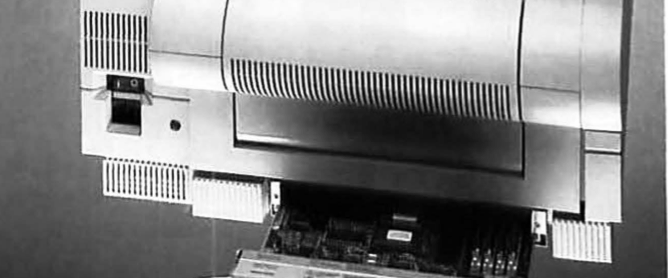
Jim Gable worked on Jonathan Eder's LaserWriter product management team as it planned the next-generation version of Apple's printer line.
The plans were for three new LaserWriter models, code-named Leia, Luke, and Vader. Vader was the high-end, and Leia was an entry-level monochrome laser printer and Luke was the mid-range model.
The upcoming LaserWriter II trio would need to interact with many programs just to print a Macintosh file. There was the PostScript interpreter, QuickDraw, the Font Manager, the Printing Manager, the LaserWriter driver, and AppleTalk. The team had to offload the tasks.
Most of the work was on building a separate printed circuit board for each new LaserWriter model. The hardware was tough because, to put it plainly, it was a more complicated computer than a Macintosh in terms of memory and the size of the board. Running Adobe’s Postscript was harder in some ways than running the Mac OS. For LaserWriter II, we stayed with the Canon line of laser printer engines but created three different controller boards to reach a ‘good, better, best’ offering.
Vader (LaserWriter IINTX) was to be a high-end laser printer for high-end users. It had the 16.67 MHz Motorola 68020 processor that could rasterize images from PostScript printer data. Complex images would print so much faster on Vader than on Luke or Leia. You could add even more built-in fonts to Vader through a font expansion board. It was a beast of a machine! Luke (LaserWriter IINT) was next - the midrange laser printer offering. It had a 12 MHz Motorola 68000 processor that could rasterize images from PostScript printer data.
Not only was this the new middle product, but we priced it to be less expensive than the previous LaserWriter. As a result, Luke became the foundation stone for desktop publishing, and people bought that printer like crazy. Luke accelerated the shift to desktop publishing, and I used to work a lot with the desktop publishing marketing teams on our products and our sales and on ideas they would have. It was a fun time to be in printing because we were changing printing around the world.
The original LaserWriter shipped in March 1985 with four fonts. Courier, Helvetica, Symbol, and Times. The LaserWriter II would include the same four original fonts and add Helvetica Narrow, ITC Avant Garde, ITC Bookman, ITC Zapf Chancery, ITC Dingbats, New Century Schoolbook, and Palatino.
To make Leia (LaserWriter IISC) a low-end offering, we eliminated AppleTalk networking and PostScript support. As a result, Leia had to ship with bitmap fonts. If a user printed 72-point type, they were fine, but if they did 12-point type, you had to grab the bit images of each letter.
The entire page, including fonts, was pre-rasterized by QuickDraw on the Macintosh computer. And while that worked, it was completely inelegant and limited. So, fonts became a big issue for Leia. Kathryn Weisberg and I worked together on the outline fonts for Leia, and unfortunately, we got into many heated debates. She was working with an outside vendor to make Times New Roman as a bit-map font that would work in Leia, but they were stylistically different than what was coming out of PostScript.
It all started because I was trying to represent a customer viewpoint for Leia. Despite its price, even though we told them that PostScript was not included, they are going to expect the output to look pretty similar. At a glance, you should not be able to tell what printer it came from, but you could. The new fonts she was getting looked “fatter.” She believed strongly that they were “better” from a professional viewpoint. She was a professional fontographer and I was a new Product Manager. And through the LaserWriter II development, we would argue. It was frustrating to us because we couldn't work out a deal with Adobe where we could use PostScript to do the font scaling on Leia.
Eventually, Gable and Weisberg resolved their ‘font war’ and led one of Apple’s greatest achievements. The democratization of fonts for all users, regardless of budget.
Excerpt from https://books.by/john-buck/inventing-the-future