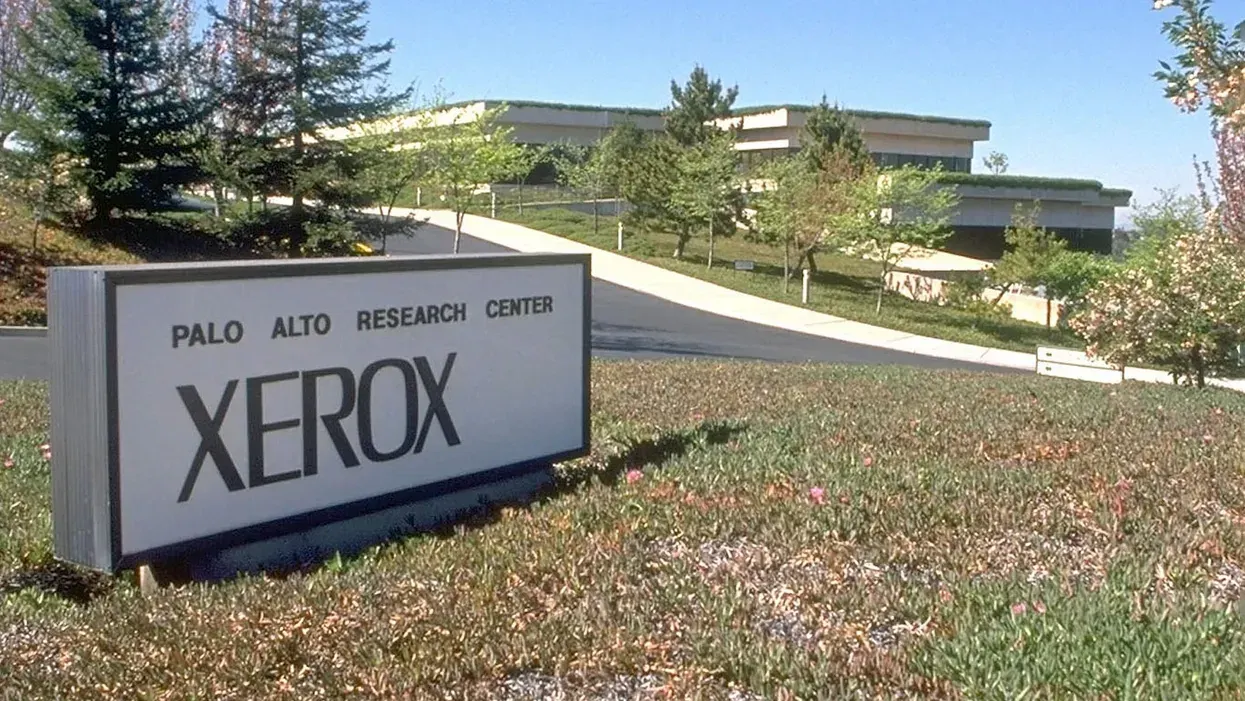
As the Homebrew Computer Club met and MITS frantically shipped Altairs, researchers at Xerox PARC were seemingly a decade or more ahead. They already knew what would make personal computers useful, and researchers were working on an ecosystem to support a typical office task. Writing and printing documents.
Gary Starkweather had tested his SLOT laser printer using analog signals, flying-spot scanners, and raw binary test patterns to prove it was capable of high-quality printing. The next hurdle was to print a document directly from a computer, however, a letter-size bitmap page contains millions of pixels, and the Alto did not have the memory or processing power to construct and manipulate such page images efficiently.
In previous years, the same task; high-quality printing was achieved with powerful graphics workstations that were able to process large bitmaps. The answer was to move the processing off the host computer.
Xerox engineer Ron Rider built a hardware controller called the Research Character Generator (RCG), to operate directly between the Alto and the laser printer. The RCG contained its own dedicated, high-speed digital memory (RAM/ROM) where font characters were stored as small, localized bitmaps. The Xerox team added a basic text-printing utility called Ear and a hand-coded typeface called Ben to the Alto. Then they sent a test to the RCG. Once it received character data, the RCG would look up an individual letter in its hardwired memory grid, find the correct sequence of 1s and 0s, and tell the laser precisely when to pulse.
The ad-hoc system, which became known as EARS (for Ethernet, Alto, Research Character Generator, and SLOT), had unblocked the printing hardware bottleneck at Xerox. But it did much more. It was a direct precursor to how, a decade later, Apple solved its own logjam with the LaserWriter and the Macintosh. Furthermore, the constraints of using hardwired bitmapped fonts became the catalyst for the creation of Adobe Systems.
In the early EARS tests, the Alto had sent a raw text file to the printer, so the next step was sending a bitmap document, and to do that required a word processing application for document creation. PARC researchers Charles Simonyi and Butler Lampson created Bravo, which allowed Alto users to mix fonts, styles, and images in a single document, viewing it onscreen exactly as it would later appear on paper. Pundit Jimmy Maher explains the seminal work:
‘It was now possible to use a variety of pleasing proportional fonts to replace the ugly old fixed-width characters of the line printers, to include non-English characters like umlauts and accents, to add charts, graphs, decorative touches like borders, even pictures.’
While the early EARS tests had succeeded in printing a few lines of characters, the visual sophistication (and density) of Bravo documents pushed the millions of pixel printing problem to the limit. To keep Bravo from choking the system, PARC scientists Bob Sproull and William Newman responded by creating a page description language (PDL) called Press. While the text print utility Ear had instructed the RCG to print characters, Press described an entire page. It bundled all of a document's layout and vector information into a compact file and sent it to the RCG. It was a paradigm-busting concept that meant the intensive task of converting huge bitmap files could be moved away from the host desktop computer and done entirely on external, faster hardware.
Now, an Alto user could compose a rich document in Bravo, hit print, and watch the Press file move over Metcalfe's Ethernet to the RCG, which translated it into a real-time electronic bitstream for the SLOT laser printer.
While the entire EARS setup still resembled a mainframe in size and was too expensive to scale commercially, the Xerox researchers knew this was a temporary hurdle of Moore's Law. Inside PARC, the ecosystem was an undeniable triumph. Starkweather adds:
‘This machine was put in place at PARC, hooked into the system and over the next year and a half printed four million copies and everyone connected the network to it. We were doing network printing from our own computers, and it was a raging success.’
Meanwhile, Xerox executives in Connecticut saw the EARS system not as a distributed personal computing prototype, but merely as a high-end standalone product they could sell to their existing corporate market. Xerox bundled a modified 9200 copier frame with a laser unit inside, drove it with a DEC PDP-11/34 as the print controller, and launched it as the 9700 Electronic Printing System. Wall Street Journal journalist James Hagerty wrote:
‘When introduced, the 9700 occupied as much space as five or six washing machines, weighed more than a ton and was priced at $295,000. It became one of the company’s top-selling products, generating more than $1 billion of annual revenue.’
The sales figures appeared to vindicate the decision by Xerox product marketing. However, the true potential of network computing architecture was missed. The opportunity of the Alto was passed to the Macintosh, Press (the InterPress) was exploited by PostScript and Bravo split into Microsoft Word and Aldus PageMaker.
Gary Starkweather later recalled:
‘I’ll never forget Einstein’s quote that “Imagination is more important than knowledge.” I think that it’s interesting because many of the failures I later saw in Xerox, and other companies, was a failure of imagination, not a failure of knowledge.’
That failure of imagination ultimately drove the scientists and the future of computing out of PARC.
Excerpt from https://books.by/john-buck/inventing-the-future
Use discount code peelings at check out